Tag: mental-health

  • Protecting Your Peace: The Power of Saying No

    Protecting Your Peace: The Power of Saying No

    We’ve all been guilty of it – agreeing to something we may or may not want to do, whether it’s an impromptu coffee meeting, an extra shift at work, or another project that can squeeze itself into our already overflowing calendar. We do it because we don’t want to let people down, we don’t want to miss out on something, or feel the pressure to keep ourselves occupied. But the truth is: sometimes, it’s okay to say no.


    Think about the last time you did something just because you ought to. Maybe it was going out when you just wanted to stay home and relax. How did that turn out? I find that trying to have a positive attitude about something I don’t wish to do can be utterly draining.


    Saying no can feel uncomfortable, especially if you’re a people-pleaser or someone who thrives with a busy schedule. But saying no is not about being selfish or rude – it’s about protecting your peace. It’s about stepping back and doing what is the best decision for you.


    For me, learning to say no has been a game-changer. I used to think that I always had to comply with whatever people asked me to do or participate in. But I discovered that I was spreading myself too thin, keeping me from doing my best when I was doing something. Now I’ve been trying to be considerate in how I spend my time. If a commitment is not going to make me happy and rather is going to stress me out, then I grant myself permission to say no.


    According to a report by an article from the University of Rochester Medical Center, boundaries prevent burnout and rather permit us to direct our energy towards things that we care about more.


    Changing the script around ‘no’ has been empowering for me. Instead of worrying about what everyone else will say if I DO NOT show up to an event, I prefer to see it as a way in which I can do whatever it takes to create space for me to be the best version of myself and put what’s in the best interest of me first. It doesn’t have to be some big deal or antisocial or lazy; it is just being intentional and deciding on what’s best for YOU.


    So, if you catch yourself feeling overwhelmed, take that as your sign to say no to something this week. Notice what happens. Maybe it’s a small no, like skipping one more social obligation. Maybe it’s bigger, like canceling a project that is uninspiring and draining. Whatever it is, allow yourself to protect your time. You may find that saying no is the most powerful thing you can do.


  • The Power of Doing Nothing: Why Taking a Break Isn’t a Waste of Time

    The Power of Doing Nothing: Why Taking a Break Isn’t a Waste of Time


    We’re living in a world where being busy and stressed is a sign of success. If we’re not working, socializing, or studying, we’re behind. But what if doing absolutely nothing is just what we need?

    I used to feel so bad about wasting time in bed scrolling through TikTok for an hour or zoning out to some random playlist. It was time I could be using getting something off my to-do list. Recently, though, I’ve started to savor those times and at times noticing the productivity hidden in taking a break.


    Why Slowing Down is Important
    College life can feel never ending– juggling classes, jobs, friends, and all the never-ending activities. There’s constant pressure to keep moving, keep working, keep socializing. With the constant flow of Instagram posts comes the stress to keep up and fill your schedule to the brim.


    But here’s the thing: Staying busy 24/7 can actually backfire. A Time article shares “stress affects the operation of every organ and system in the body, including the immune system.” So why would we let ourselves reach unhealthy ammounts of stress with no rest?


    What “Doing Nothing” Can Look Like
    When I say, “doing nothing,” I don’t mean binge-watching a new series in a marathon or scrolling aimlessly through TikTok. I mean giving yourself permission to actually disconnect. No phone, no laptop, no stressors.

    Doing nothing for me is:

    – Lying on my bed and staring at the ceiling.

    – Taking a color walk.

    – Sitting outside.

    – Setting a timer and letting my mind wander.

    – Coloring in a fun coloring book.

    These might feel awkward or like a waste of time at first – but trust me soon you will find yourself building in time to just be.

    Why Doing Nothing Is Actually Doing Something
    Surprisingly, doing nothing is an incredibly effective way to recharge. According to Harvard Health, resting without interruption can decrease stress levels, boost creativity, and even help you work through feelings you’ve been holding back.


    Personally, I’ve found I feel more balanced when I allow myself to do nothing. Giving myself permission to take time to reset is essential these days. My head clears, and I notice things that I would otherwise have missed out on if I’d been running around with a mind full of a million things. Allowing yourself to take breaks, even if it is hard and awkward at first, can make all the difference.

  • Logging Off to Tune In

    Logging Off to Tune In

    It is no secret that we, as a society, have become reliant on our screens. The American Psychological Association reports that teens spend, on average, 4.8 hours a day on social media. This doesn’t surprise me – between school, social media, texting, and of course mindless scrolling I use my phone for basically everything.

    Reaching for my phone has become this built-in time filler integrated into nearly every task. Now don’t worry this isn’t going to be a post on how we should all get off our phones forever. I do believe there are certain benefits to using our phones. But recently, I have been questioning how can I unplug without feeling like I’m missing everything?

    NPR reported that 91% of people felt better after blocking the internet from their phones for just two weeks. As a college student, I’m not sure this was a realistic path for me to help break the doom-scrolling habits, but this opened my eyes to what a small change can do.

    My Mini Detox

    When Lent came around, I decided to give up social media at night. This felt like a good step toward living life a bit more unplugged. I had my roommate create a screentime password and lock my apps to hold myself accountable. I knew this would be challenging but I didn’t anticipate struggling as much as I did.

    Turning off my phone at night was actually a relief. This allowed me to focus on my nighttime routine and prepare for the next day. The challenge came when I’d wake up in the middle of the night and didn’t have TikTok to scroll through to fall back asleep. With social media blocked, I found myself scrolling through anything and everything I could find on my phone. This was the moment I realized I needed this push toward being unplugged.

    Although this was hard there were other aspects of this that helped me build space between my phone and the urge to scroll. Now, I find myself assuming that screen time notification is about to pop up each night – and sometimes I even wish it did.

    I have learned that yes, I might be the “screenager” I tried so hard not to become. But also, being unplugged doesn’t have to happen overnight. Slowly phasing out habits that are blocking you from connecting with others can be the first step to finding your balance in being unplugged.

    Here are 5 things that helped me replace scrolling

    1. Listen to a podcast.
      • My go to podcast has been the Mel Robbins podcast, this allowed me to focus on something else without having to stare at a screen.
    2. Go on a walk or move your body!
      • I find myself feeling antsy without the mindless scrolling. A five-minute meditation, walk, or yoga helped me clear my head and get out some energy.
    3. Leave your phone at home (when you can).
      • I get that having your phone on you can feel like a safety net. But when you’re with people you trust, try leaving that phone at home and connect with those around you.
    4. Read.
      • It sounds basic, but picking up a book that is interesting to you (not an assigned reading) can act as a good way to reset your mind.
    5. Let your phone die.
      • At times I find myself scared of my phone hitting 1% battery, but I have been trying to let it die and challenge myself to charge it only once a day. This acts as my own kind of “screen time” notification.

    Balance doesn’t mean cutting technology out altogether. It means using your screens more intentionally. Even a brief time offline can make all the difference. And hey, you might even enjoy life a bit more unplugged. I encourage you to log off – just temporarily and tune in to what is around you.

  • Mental Wellness at Your Fingertips: How Calm Is Leading with Purpose

    Mental Wellness at Your Fingertips: How Calm Is Leading with Purpose

    As the mental health crisis continues to grow across the United States, providing people with access to mental health and wellness resources is more crucial than ever. According to the Centers for Disease Control and Prevention, one in five adults experience anxiety and depression. Despite these numbers, many people still don’t have access to affordable mental healthcare.

    Calm’s Commitment to Corporate Social Responsibility

    The Calm app aims to address this issue by offering free and premium meditation, sleep, and wellness resources to help users find balance in their daily lives. The app was founded in 2012 and has seen success over the years, earning the title of iPhone App of the Year in 2017. Since then, it has grown with over 150 million downloads. Today, the Calm app partners with businesses and healthcare providers to help more people access the support they need.

    Calm Logo In the App Store

    This blog post explores Calm’s approach to corporate social responsibility and how the company encourages other organizations to provide employees and customers with mental health resources. Corporate social responsibility encourages companies to assess their impact on society, focusing on more than just profits. With Calm’s free resources, mental health resources are right at people’s fingertips. By focusing on expanding mental health resources Calm has displayed corporate social responsibility, setting an example for other companies to provide access to mental health care. One example of this is Calm’s ongoing partnership with Kaiser Permanente.

    Calm x Kaiser Permanente Partnership

    The partnership began during the COVID-19 pandemic in 2020 when stress was at an all-time high. Many were scared to leave their homes, and Calm provided support from anywhere. This partnership offered Kaiser members a free premium subscription that includes guided meditation, sleep stories, breathing exercises, masterclasses, and other wellness resources. Members got emails letting them know about this exciting partnership which not only raised awareness about Calm but also opened a larger conversation about online mental health resources.

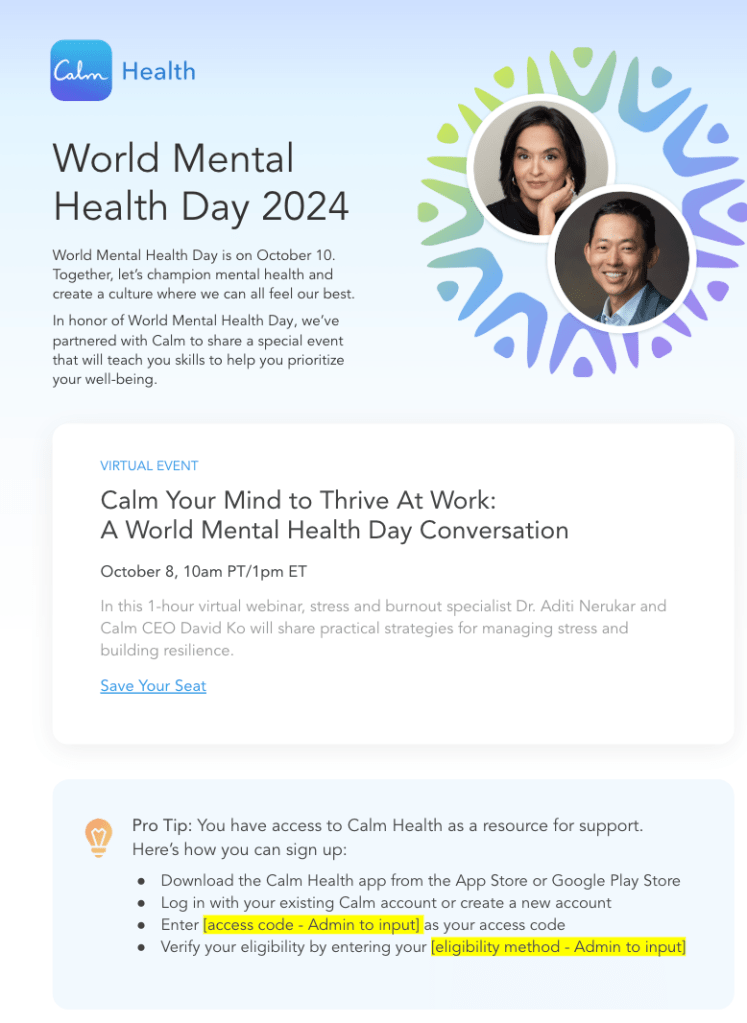
     Additionally, the two companies hosted the virtual World Mental Health Day event. This allowed people to hear personal stories from others and take a deeper look at strategies to manage mental health challenges. This event was promoted on social media accounts and company websites, raising awareness across both audiences.

    Flyer from https://www.calm.com

    Effective Digital Campaigns

    In a digital age, it is helpful to promote events on social media as it is both an effective and low-cost option for raising awareness and increasing engagement. Utilizing the many forms of media has helped Calm promote its app and share snippets to get people more interested in what it is about. Posts and flyers that offer information in a concise and visually appealing way can be helpful in spreading awareness about campaigns and events. Since this is an app, users and potential users are more likely to check either social media or emails reminding them of events and special offerings. With the app’s growing success, it is clear they are reaching those who could benefit from the various tools offered.

    Calm’s Lasting Impact

    The Calm app is all about providing people with access to mental healthcare and this partnership, as well as similar ones, has helped encourage people to focus on their well-being. By providing free and accessible mental health tools, Calm has allowed many people to access help they may not have been able to get. Partnerships have also encouraged other companies to offer mental health resources and fight this mental health crisis. Opening the conversation about mental health helps break the stigma and encourages people to take charge of their mental health. Calm has helped people and companies take responsibility and fight the mental health crisis.

  • Tips for Staying Mindful During Midterms

    Tips for Staying Mindful During Midterms

    As midterms approach, I have found myself feeling overwhelmed and completely unbalanced. It can be easy to fall into the whirlwind of strict deadlines and skip out on taking time for yourself.

    In 2024 the American Institute of Stress shared“45% of American college students report experiencing “more than average stress”(Stress.org).

    Making an effort to maintain balance during these chaotic times is essential to your success. I have made a list of some of my personal, realistic ways of making time for myself while not losing track of the work I have to complete.

    Here are four practices that help me:

    1. Break Down Your Days into Phases
    Life can feel overwhelming when you have so much on your plate. The way I’ve been approaching this is by breaking my days into phases. On days that I have so many things going on, a long to-do list can feel daunting and unattainable. Instead, breaking it into chunks makes it feel more approachable and achievable. For example, phase one can be school tasks, phase two work or other activities, and phase three winding down. Some days I find myself with three phases, and other days I have five. Reframing days to be more manageable can make all the difference in these busy times.

    2. Make Time for Your People
    Locking yourself in your room or the library can feel like the answer to all your problems, and it may for a little bit, but looking at a computer all day can make you feel more like a robot and less like a human. Take time to see your friends. This can be planning a walk, a coffee run, or even just a quick call. Working this into your schedule can help you see life outside of midterms.

    3. Prioritize sleep.

    Pulling an all-nighter to study can feel so tempting when you’re stressed and feeling unprepared. The truth is, you need sleep to learn. In an article published on News in Health, it was reported that “if you haven’t slept, your ability to learn new things could drop by up to 40%” (check it out here). So, taking that time to sleep and process new information is incredibly beneficial and important to prioritize.

    4. Clean Your Room!
    The “depression room” we see on TikTok can easily become a reality. When life feels so busy, it can be easier to throw your things down as you’re on the go. Taking time every day to clean your space can really help set you up for success. Before bed, set your alarm for 15 minutes, put in some earbuds, and take time to clean and prepare for the next day. This practice has allowed me to take time for myself while also being productive.

    Midterms can be tough and overwhelming, and it’s normal to feel those feelings. It’s also important to take time for you and balance your work with yourself. You may not get it right every day, but making a conscious effort to fit some self-care into busy days can make a huge difference.

  • The Power of Connection: Spotlight on Active Minds

    The Power of Connection: Spotlight on Active Minds

    Surrounding yourself with people who lift you up is one of the best lessons I have learned. Having friends who are there to support you is something so important. A non-profit I would like to highlight focuses on creating space for young adults to talk about mental health and well-being.

    Active Minds Logo

    What is Active Minds?

    The nonprofit organization Active Minds uses peer connection to help change the conversation about mental health. Its mission is to “mobilize youth & young adults to transform mental health norms across society” (Active Minds). They create programs where students can support each other and have meaningful discussions with their peers about their well-being. Today, Active Minds is on over 1,000 campuses and in communities facilitating conversations and creating a safe space where people can feel seen, heard, and understood.

    Send Silence Packing

    One of their main events is Send Silence Packing, where they visit 60-80 schools and set up backpacks to represent those who have lost their life to suicide. This visual helps students see the many people who struggle with mental health while encouraging them to have those hard conversations and lean on their community when they need support.

    This peer-to-peer support is what makes Active Minds stand out to me. Meeting young adults where they are helps make mental health a more approachable topic. On their social media accounts, they share tips on managing stress and stories from those who have been impacted by Active Minds.

    Why is this important?

    In a world that feels so busy, it’s easy to get overwhelmed and lost. Finding a space where you feel comfortable having open conversations about how you are doing can help you and others around you. For some, it may take a more structured community like Active Minds. For me, I have found community through the friendships and support systems I have built. Knowing I have people who hear me and listen without judgment has helped me understand that it’s OK to feel lost or to ask for help. I encourage you to think about your community — spaces where you feel heard and supported — and lean on them when life feels busy and out of balance.

    In the same way, be there for others. A quick call, a thoughtful text, or inviting someone to go on a walk can make all the difference. Being part of a community is not just about finding support, but about offering it too.